
RAINN - Navigating the Healing Journey
This blog post is the sequel to RAINN’s first post written for Yoga to Cope “Getting the Facts about Sexual Violence.” Written by guest contributing writer Keeli Sorensen of RAINN.
This #wellnesswednesday Yoga to Cope brings back RAINN, the Rape, Abuse, & Incest National Network, an organization providing resources for individuals who have experienced sexual violence. RAINN is the nations largest organization focused on anti-sexual violence.
RAINN was on Yoga to Cope’s podcast last week, where Ebonique Bethea, the Clinical Director for RAINN, discusses her role as a trained Social Worker. In this podcast she shares her insights and experiences related to stress management this time of year, how to head home for the holidays with care, how to set boundaries during the holiday season if you may encounter an individual who has caused harm, the short and long term effects of sexual violence, as well as the resources RAINN provides.
Please note that the topics disclosed here may be perceived as sensitive, resources are provided throughout this post.
Navigating the Healing Journey
Every path is different
By Keeli Sorensen, vice president of victim services at RAINN
In the aftermath of a sexual assault, it can be hard to navigate what to do next. Healing is an ongoing process, and it looks different for each person. No two survivors will heal from trauma in the same way. Some survivors may not seek help right away, and they may wait to begin their healing journey for years or even decades. That’s okay, too. It’s perfectly normal to wait before seeking resources or support.
In the immediate period after an assault, or during the healing journey that follows, RAINN’s National Sexual Assault Hotline (800.656.HOPE, online.rainn.org, or in Spanish at rainn.org/es) can help. The hotline is free, confidential, available 24/7 and connects survivors with trained support specialists who can provide the tools to plan next steps, including safety planning, finding medical attention, navigating reporting considerations, and locating supportive mental health resources.
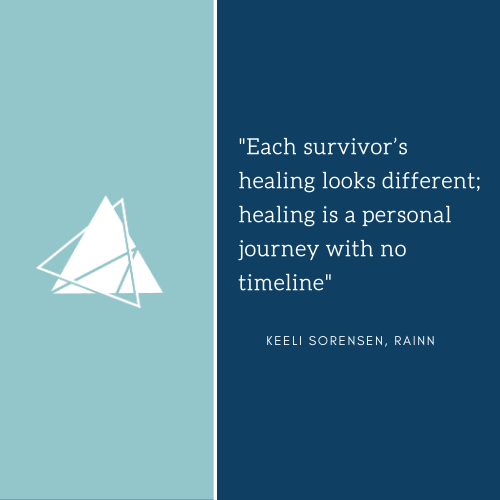
Each survivor’s healing looks different; healing is a personal journey with no timeline. For Sandra, she preferred not to tell anyone for 20 years following her experience with assault: “I reconnected with my high school boyfriend and we started dating again. He asked me about what had happened, so I told him. It was the first time I ever shared the details of my story. It was like reliving it. But it opened the door to start my healing process.” Opening up about their experiences is difficult for many survivors, as they revisit painful memories, but it can also be a step toward healing.
For many survivors, healing begins with confronting feelings of self-doubt and self-blame. It is common for survivors to feel that they are responsible for what happened to them—it’s a natural reaction to trauma and it can be caused by trying to retain a sense of control and make sense and meaning out of what happened. But sexual violence is a crime and a violation. No matter the circumstances, if someone engaged in sexual activity without consent, it’s not the survivor’s fault. After being assaulted as a child, Keith says, “The real healing was achieved when I started to sincerely believe I’m not responsible for what happened to me.”
Sarah also struggled with this, especially after her partner at the time responded in an unsupportive manner: “I was an insecure teenager in a relationship with someone who told me I cheated on him [when I was assaulted] and was a horrible person. I kept wondering if he was right. When I started working on myself and my self-confidence, I realized it was not my fault.”
An unsupportive initial reaction–like the one Sarah experienced–can make it difficult for a survivor to seek support from anyone else. Disclosing can feel vulnerable and scary, so being met with an appropriate and supportive response is crucial. The TALK acronym is a good start for learning how to respond to a survivor: (T) Thank them for telling you, (A) Ask how you can help, (L) Listen without judgment, and (K) Keep supporting. For a more thorough guide on supporting a survivor in your life, see RAINN’s Family and Friends Toolkit.
Self-care is another important—and ongoing!—step in the healing process for many survivors. Just like the healing journey itself, self-care is something that can look different for everyone. Many survivors find that developing ways to reconnect with their bodies in positive ways is very healing. This can look like physical activities such as exercising, spending time in nature, dancing, or a hot bath or shower. For instance, yoga helps bridge the gap between mind and body and can enhance a feeling of connection with oneself. Yoga to Cope provides free yogic-based resources such as guided meditations to help survivors heal and reconnect with their bodies. For Samentha, she began to explore her emotions through lyrical dance, saying “I was able to create something so beautiful out of something that was just...not.”
Some survivors find creative outlets to be helpful because they can connect us to a sense of purpose or a sense of hope. Activities like journaling, blogging, creating art, or making music can be healing. For Leilani, writing is a way of taking back agency over her story and experiences: “Through all of this, it’s been important for me to remind myself to keep writing, to keep doing something I love. I’m taking control of my own narrative.”
For other survivors, like Ethan, healing involves trying different things and finding what works best for him: “There were a lot of calming activities, like meditation and baths, that weren’t for me. I’m not a serenity person. I love playing video games online with my younger brothers to get out my frustration—they’re cathartic and don’t hurt anyone else!”
Staying close to a beloved pet can be extremely helpful for many survivors. Tarhata’s rescue dog, Bonkers, helped her to feel comfortable outside again on their walks. “My dog was everything to me. When I was scared to go outside, he would walk with me. When I didn’t eat, he would eat with me. Everything that made me feel uneasy, he would be the one to keep me calm. Bonkers came to all of my speaking events—everyone knew him. It’s funny how a little rescue dog can rescue you.”
It’s okay if your healing journey doesn’t look like other people’s. Healing is not a linear process, and there will be twists, turns, and bumps in the road along the way. The important thing is to keep reaching out for help and trying new things until you find what works best for you.
For regular self-care tips and messages of hope, healing, and advocacy, connect with RAINN by subscribing to our monthly newsletter and by following us on our social media channels, including Facebook, Twitter, Instagram, and TikTok.
Keeli Sorensen is the vice president of victim services at RAINN, the nation’s largest anti-sexual violence organization, where she provides strategic and operational leadership to the National Sexual Assault Hotline and more than 20 other hotlines that RAINN operates for public and private sector clients.